

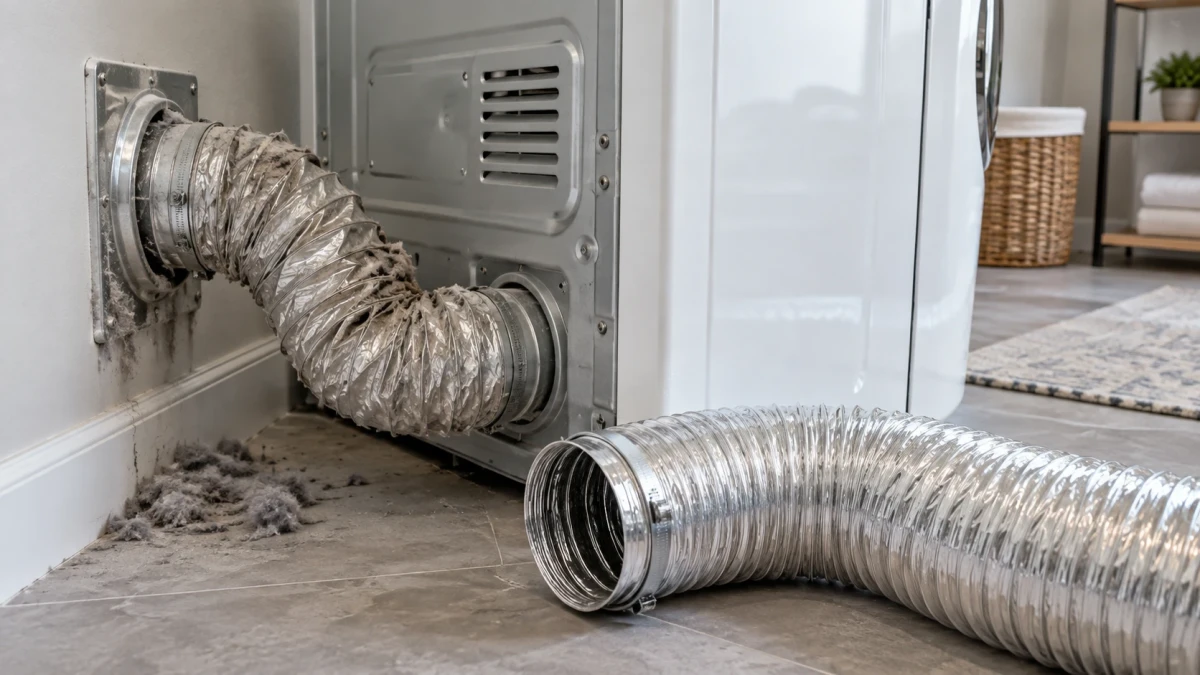
A dryer vent hose is a wear part, not a permanent fixture. Cleaning removes the lint inside it, but no cleaning can fix a hose that is crushed, torn, kinked, or made of the wrong material. That is why most homes need a new hose every few years, and some need one right away, even when the vent has been cleaned on schedule.
Most homeowners think of dryer safety as two habits: empty the lint trap after every load and have the vent cleaned once a year. Both matter. But the short flexible hose behind the dryer takes more abuse than any other part of the system, and it is often the part that quietly fails first.
What the Dryer Vent Hose Actually Does
The hose, also called a transition duct, is the short connector between the back of your dryer and the rigid duct that runs through the wall, floor, or ceiling to the outside. It has to be flexible so the dryer can be pulled out and pushed back. That flexibility is exactly what makes it vulnerable.
Every load sends hot, moist, lint-laden air through it. Over the years the hose is heated and cooled thousands of times, shaken by the drum, and bent every time someone moves the dryer to clean behind it or reach a dropped sock.
Why Hoses Wear Out Even When You Clean Them
Professional dryer vent cleaning removes lint from the hose and the duct, and it remains the most important thing you can do for dryer safety. Still, a clean hose can also be a damaged one. Here is what happens to flexible hoses over time:
- Crushing and kinking: Pushing the dryer back against the wall flattens the hose. A partly flattened hose loses a large share of its airflow, and lint settles at every pinch point.
- Tears and pinholes: Thin foil splits along its ridges. Even a small hole lets warm, humid air and lint escape into the laundry room or the wall cavity behind it.
- Loose connections: Clamps and tape loosen with heat and vibration. A hose that slips off the dryer outlet can blow lint behind the machine for weeks before anyone notices.
- Lint stuck in the ridges: The accordion ridges of a flexible hose hold lint in a way smooth metal duct does not. An older, stretched hose holds on to even more of it, right after a cleaning.
None of this happens overnight, which is why there is no official replacement date. Condition is what decides it. In a typical household that runs several loads a week, though, a flexible foil hose usually shows enough wear within a few years that replacing it is both the safer and the cheaper choice.
Why a Worn Hose Is a Fire Risk
According to the U.S. Fire Administration, clothes dryers cause roughly 2,900 home fires each year, and failure to clean is the leading factor. A damaged hose makes that risk worse. Every kink and flattened section slows the air, slower air drops more lint, and the dryer runs hotter and longer to compensate. The hose sits right behind the heat source, so it is the worst possible place for lint to pile up.
Plastic and Vinyl Hoses Should Go Right Away
If the hose behind your dryer is white plastic or vinyl, its age does not matter: it should be replaced now. The U.S. Consumer Product Safety Commission advises replacing plastic or foil accordion-type ducting with rigid or semi-rigid metal duct. Plastic sags, traps lint, and can melt or burn if a fire starts inside it.
If your current hose is the thin foil accordion type, a replacement is also a good moment to move to a semi-rigid metal connector. It holds its shape better when the dryer is pushed back and has fewer ridges for lint to cling to.
What the Code Says About the Hose Behind Your Dryer
The International Residential Code, which most U.S. jurisdictions adopt in some form, sets clear limits on this connector:
- It must be a single length that is listed and labeled for dryer use.
- It cannot be longer than 8 feet.
- It cannot be hidden inside walls, floors, or ceilings. The duct that runs through the structure must be rigid metal with a smooth interior.
Many older installations break at least one of these rules: a long foil hose snaked through a ceiling, or two hoses taped together to reach the wall. In Chicago area basements, where the vent often exits through the rim joist, it is common to find a hose that has been stretched, looped, or bent just to make it fit. In those cases, replacement is not only about wear. It brings the setup back to where it should be.
Signs Your Dryer Vent Hose Needs Replacing
- Clothes still need more than one cycle to dry, even right after a vent cleaning.
- The laundry room feels unusually warm or humid while the dryer runs.
- You find lint on the floor or the wall behind the dryer.
- The hose is flattened, kinked, torn, or patched with tape.
- The hose is plastic or vinyl, or nobody remembers when it was last replaced.
- You notice a burning smell while the dryer runs. In that case, stop using it until it has been inspected.
For warning signs on the duct side of the system, see our guide on signs it is time to clean your dryer vent.
Don’t Forget the Other End: The Exterior Vent Cover
The hose is not the only part that wears out. The vent cover on the outside of the house takes years of sun, wind, and freezing temperatures, and Chicago winters are especially hard on it. Flaps crack or stick open, louvers break, and an open or damaged cover invites birds and rodents to nest in the warm duct. A single nest can block airflow completely.
The fix is a bird guard cover with openings large enough for lint to pass through freely. Avoid fine mesh screens, because they catch lint and can clog the vent, as we explain in The Hidden Dangers of Using Screens in Dryer Vents.
The Easiest Time to Replace Them
The best moment to replace the hose or the exterior cover is during a dryer vent cleaning, when the dryer is already pulled out and the system is open. AAA Cleaning Services INC offers dryer vent hose replacement and bird guard cover installation as an add-on to any of our cleaning services, at a flat rate with no hidden charges. While we clean, we can check both parts and tell you honestly whether they still have life left or should be replaced.
Frequently Asked Questions
How often should a dryer vent hose be replaced?
No code sets a fixed date. Check the hose at every annual vent cleaning and replace it as soon as it is crushed, torn, kinked, or loose. In busy households, a flexible foil hose typically needs replacing every few years. Plastic or vinyl hoses should be replaced immediately.
Is cleaning the hose enough, or do I need a new one?
If the hose is intact, cleaning is enough. If it has holes, flattened sections, or tape repairs, cleaning will not restore proper airflow, and a new hose is the better choice.
What type of dryer vent hose is safest?
A metal transition duct that is listed and labeled for dryers, ideally semi-rigid, kept as short and straight as possible and never longer than 8 feet. Avoid plastic and vinyl entirely.
Can I add a dryer vent hose replacement or bird guard to my cleaning visit?
Yes. Both are available as add-ons to any of our cleaning services, so everything is done in a single visit.
If the hose behind your dryer has not been looked at in years, it is probably time. To schedule a dryer vent cleaning with a new hose or bird guard cover, reach out to AAA Cleaning Services INC through our contact page.